



Difference between True vs. Pure, and Direct vs. Indirect Democracy
November 9, 2024
How to End All Wars in the World Today
November 12, 2024

The “Two-Party System” Explained
Many scholars debate how to solve or change the “two-party system” due to its associated problems. They often propose, as solutions, alternative “voting systems” such as Ranked Choice or Approval Voting over First Past the Post (FPP).
Some History
First, it is important to note that there is no formally instituted “two-party system” in any country. In fact, political parties were not even meant to be part of the “republics” we have today (what many wrongly call “democracies”). The designers of this system of governance originally designed the system not only to NOT incorporate political parties but, in their own words, to actually prevent the formation of political parties!1 This was a main goal of the system we have today. Parties, however, regardless, soon emerged on their own, took over the system, and quickly came to be accepted as part of the system; this was against a strong warning from the first president to rule under this system, about the dangers political parties pose.2 In spite of this, political parties, over time, came to be formalised by many countries which adopted or replicated this system of governance.
With party politics having become normalised or even formalised in many countries as an unintended consequence rather than deliberate design, this party politics has also generally tended to result in a duopoly in many of such countries (what is sometimes wrongly referred to as a “two-party system”).
Duopoly Defined
A duopoly in politics is when two political parties become dominant in a country, becoming practically impossible to defeat or unseat, for many generations, in spite of growing frustrations with their dominance.
As it turns out, a duopoly persists in many “democracies” today.
How and why does it happen and how can it be solved (given the many problems associated with it)?
Duopolies NOT Caused by “Voting Systems”
The voting method (often termed “voting system”) is NOT responsible for the emergence of duopolies, contrary to what many scholars today believe.
Voting is only a method of arriving at a decision. It is one of many methods which can be used for making a choice in a democracy as well as in other forms of government; and voting itself can take several more specific forms. Specific voting methods may have various advantages over one another but voting, generally, regardless of the form it takes, is merely tangential to the equation and does not deal with the actual problem.
Causes of Duopolies in Politics Today
The system of governance itself is what creates and reinforces a duopoly.
The systems of governance we have, by design, ensure that AT MOST two political parties become and remain dominant, always, no matter what anyone else does to try to change that.
Many smaller parties across the world have lost, and continue to lose, huge fortunes in hopes of breaking duopolies in their countries to no avail, for many generations. Often, newer or smaller parties are driven by the idea or hope that it is possible to change their fortunes if there are:
- Long-standing and growing frustrations with the duopoly
- Damning reports on the failures of parties in the duopoly
- Far better ideas, policy proposals or manifestos coming from smaller parties
- Desire for change among the youth or new generations and/or
- Immense resources available to them for campaign spending
The forces that reinforce duopolies are, however, stronger than any of these factors, regardless of how positive they are, and even the best efforts of third parties hardly makes a dent in outcomes, election after election, in many countries across the world. Why? The sooner new or smaller parties can recognize and accept the real problem, the sooner they can explore alternatives that actually can work for change.
As we have already noted in the opening paragraphs, the systems we presently call “democracies” are not actually democracies but “presidential (and thus autocratic) republics;” this fact is explained in some of our other posts and is very important!
Among the “republics” or “quasi-republics” we have today, countries with presidential systems have the duopoly problem the most, and this is not by accident.
How the System of Governance Creates a Duopoly
Presidential systems concentrate power in the presidency, and create competition for this office. This competition for power, exercised in an environment that allows teams to gang up (as political parties), to claim that power, ensures that the competition devolves, and divides the country, into a competition between the largest or strongest two camps or parties. It will always boil down to the “last two.”
Now, after one or two sides consolidate power or popularity, whenever newer or smaller parties try to disrupt this hold on power, presenting themselves as a better option, they hope to draw in votes of discerning people from one of the major parties, but this only creates room for the worst of the duopoly to win! Given that elections in this system is a high-risk and high-stakes situation, none can afford such risks lest they be left with a terrible choice for another 4 years (and for eternity as it persists)!
Therefore, any attempts to dilute the votes of any of the major parties only drives them further, even the better voters amongst them, to reinforce what they consider to be at least the lesser of two evils or parties guaranteed to win the elections. This cycle constantly reinforces itself – the more people try to change it, the stronger it gets – and data in Ghana, the U.S., Kenya, Australia and many other countries shows it.
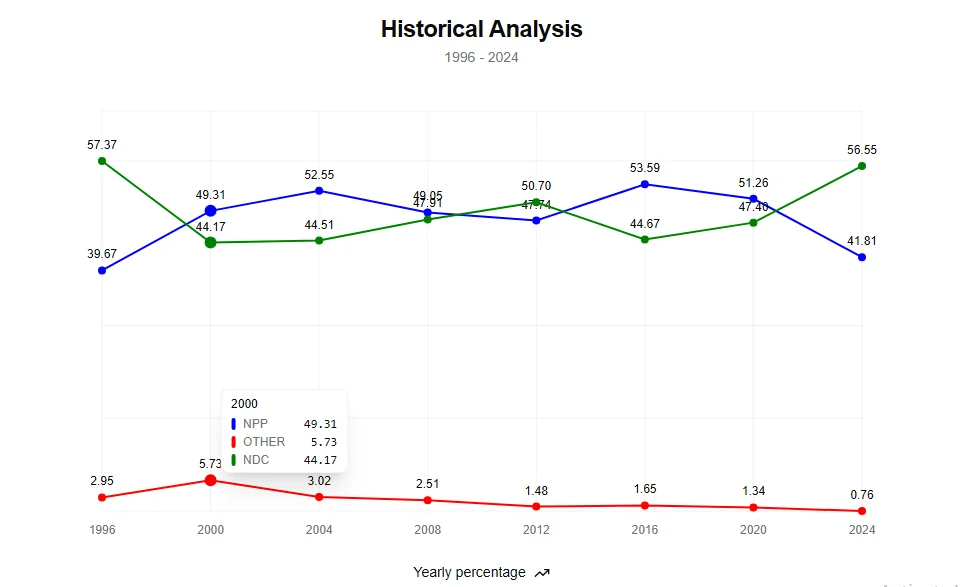
Trend of presidential election results in Ghana, from 1996 to 2024 © citinewsroom
Countries like Switzerland, and to some extent Germany, which do not CONCENTRATE POWER in a single autocrat (as in a president) DO NOT have these problems as much; especially Switzerland which has a more diffused system of governance, they do not suffer too much from duopoly. That is the key here, the more a constitution concentrates power in an office and creates competition for that office, the more a duopoly results. and persists.
For this same reason, countries with strictly parliamentary systems (like the U.K. and others) where control of parliament (rather than control of a presidency) is the primary goal of their politics (because parliament is the locus of power in such countries), their kind of politics also has a slightly different dynamic. As a result you don’t have too much of a duopoly there, but still end up with dominant parties, and then smaller parties reduced to playing alliances with the larger party(s); by offering control of parliament as their bargaining chip. In these cases, however, the core problem still remains, as the country is essentially split into two coalitions.
If you change the voting method under any of these systems of governance, the core problem will remain; and, especially under the current systems, the competition for power, the role of money and its negative influence in politics, and the exclusion of more intelligent minds and people among the masses from governance and politics, will all remain.
Solution to the “Two-Party System” (Duopoly)
The solution to the problem of duopoly in politics therefore lies in changing the system of governance itself (that is, constitutional changes), to remove the competition for power, and distribute power properly to the people, which will in turn shift focus away from dirty party politics for power, and focus everyone’s attention unto issues and proper planning and problem-solving instead. There are ways to achieve this, as in a true democracy. These are, however, much broader and diverse conversations to be had, which cannot fit into a single article. Explore other posts on our page to learn more, or better yet get our source materials with all the details and references.
Footnotes
- See the Federalist Papers.
- See George Washington’s farewell address.
Source: The Tragedy Called Democracy in the 21st Century (2023) pp. 217-239